AMBLYPYGI
Mahahual · Selva Maya · Arácnidos · Vida nocturna
Parece una criatura salida de otro mundo, pero el amblipigio es uno de los arácnidos más fascinantes del planeta: sin aguijón, sin glándulas de veneno, equipado con enormes patas sensoriales y capaz de orientarse en la oscuridad con una precisión sorprendente.
Mahahual · Maya Forest · Arachnids · Nocturnal wildlife
It may look like a creature from another world, but the whip spider is one of the planet’s most fascinating arachnids: no stinger, no venom glands, enormously elongated sensory legs and remarkable nocturnal navigation.
La primera reacción suele ser miedo. La segunda, cuando descubres qué estás viendo, suele ser fascinación.
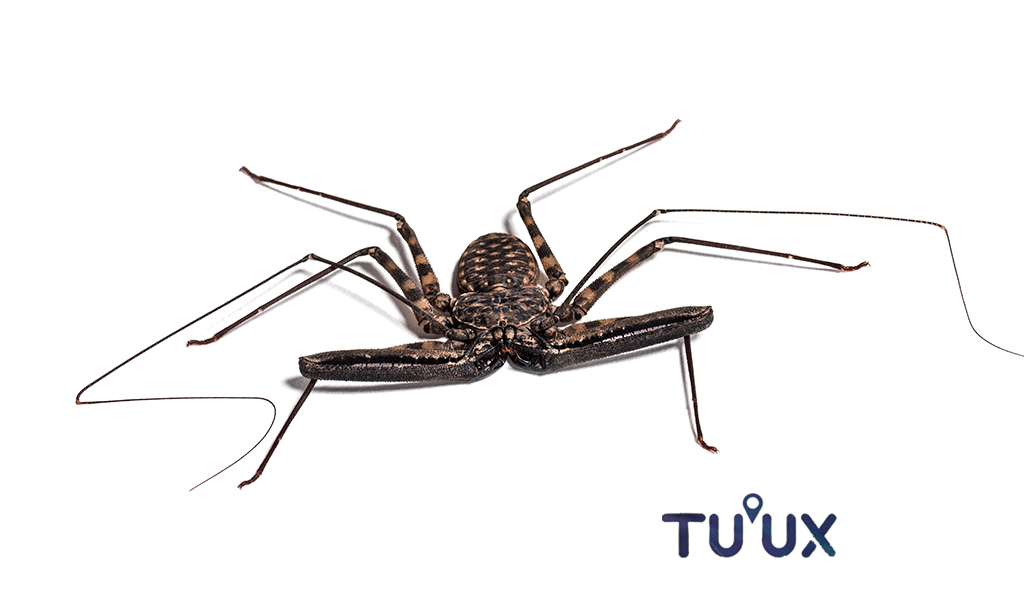
Los amblipigios tienen un cuerpo plano, pedipalpos cubiertos de espinas y unas patas delanteras tan largas que parecen antenas.
Y en cierto sentido eso es exactamente lo que son.
El primer par de patas prácticamente dejó de funcionar como patas locomotoras durante la evolución. Hoy actúa como uno de los sistemas sensoriales más extraordinarios entre los arácnidos.
Fear is often the first reaction. Fascination usually comes next.
Amblypygids have flattened bodies, powerful spiny pedipalps and enormously elongated front legs that resemble antennae.
They have no stinger and no venom glands. Their normal response to a threat is retreat, although a restrained animal may defend itself with its pedipalps.
🧬 ¿Qué es realmente un amblipigio?
Amblypygi es un orden de la clase Arachnida.
Por eso está emparentado con arañas, escorpiones, vinagrillos y otros arácnidos, pero no es una araña ni un escorpión.
Los nombres populares “araña látigo” y “escorpión látigo sin cola” describen su apariencia, no su clasificación zoológica.
🕷️ Clase
Arachnida
🔬 Orden
Amblypygi
🦵 Ocho patas anatómicas
Pero solamente tres pares cumplen normalmente la función principal de caminar.
📡 Primer par
Está transformado en patas anteniformes sensoriales.
🧬 What exactly is an amblypygid?
Amblypygi is a distinct order within Arachnida. It is therefore related to spiders and scorpions, but is neither a true spider nor a scorpion.
Anatomically it still has eight legs, but the first pair has become highly specialized sensory appendages.
🔍 Anatomía de una criatura extraordinaria
📡 Patas anteniformes
Extremadamente largas y cubiertas por numerosos receptores químicos y mecánicos.
🦞 Pedipalpos raptoriales
Grandes, articulados y provistos de espinas. Funcionan como estructuras de captura.
🪨 Cuerpo aplanado
Facilita entrar en grietas, espacios bajo corteza y refugios estrechos.
👁️ Ojos
Poseen ojos, pero muchas especies dependen fuertemente de información táctil y química.
📡 Un mundo percibido con las patas
Tocar, oler y navegar sin depender de una gran visión
Las patas anteniformes poseen una enorme variedad de estructuras sensoriales capaces de detectar información mecánica y química del entorno.
Con ellas exploran superficies, localizan obstáculos, inspeccionan refugios, interactúan con otros individuos y obtienen información útil para orientarse.
El sistema nervioso de estos animales también posee estructuras cerebrales especialmente desarrolladas relacionadas con procesamiento sensorial, aprendizaje y memoria.
🧭 Pueden encontrar el camino de regreso a casa
Esta es una de las capacidades mejor estudiadas de los amblipigios.
Experimentos con Paraphrynus laevifrons desplazaron individuos aproximadamente 10 metros desde su refugio.
Los animales con visión bloqueada todavía fueron capaces de orientarse hacia casa.
Pero cuando los investigadores redujeron la información sensorial recibida por las puntas de las patas anteniformes, la capacidad de orientación prácticamente desapareció.
En esos experimentos, la memoria asociada al olor del refugio permaneció al menos dos semanas.
🧭 Finding the way home
Experimental studies found that whip spiders could orient back toward a shelter after being displaced about ten meters.
Blocking vision did not eliminate this ability. Disrupting sensory input from the antenniform legs, however, severely impaired navigation.
Other experiments show that shelter odors can be recognized and remembered for at least two weeks.
📍 Amblipigios de la Península de Yucatán
La información científica regional es mucho mejor de lo que suele aparecer en artículos turísticos de internet.
Una revisión de la Universidad Autónoma de Yucatán publicada en 2017 reunió cinco especies de Amblypygi registradas para la Península de Yucatán.
El World Arachnida Catalog continúa reconociendo estos nombres como especies válidas en 2026.
🕷️ Paraphrynus chacmool
Especie registrada en Campeche, Quintana Roo y Yucatán en la revisión regional. Su nombre específico hace referencia a Chac Mool.
🕷️ Paraphrynus raptator
Registrado ampliamente en la región y particularmente conocido en sistemas cavernícolas de la Península.
🕷️ Paraphrynus reddelli
Especie mexicana descrita a partir de material de Actún Loltún, Yucatán.
🕷️ Phrynus cozumel
Su localidad tipo es Isla Cozumel, Quintana Roo. Sigue reconocida como especie válida.
🕷️ Phrynus parvulus
Especie centroamericana también registrada en México y en estudios de la fauna de Quintana Roo.
🔬 ¿Y Mahahual?
Los registros regionales confirman que Amblypygi forma parte de la fauna de Quintana Roo. Sin embargo, no contamos actualmente con una revisión taxonómica publicada que permita afirmar qué especie exacta habita específicamente en Mahahual.
📍 Whip spiders of the Yucatán Peninsula
A 2017 review of arachnids from the Yucatán Peninsula documented five amblypygid species: Paraphrynus chacmool, P. raptator, P. reddelli, Phrynus cozumel and P. parvulus.
These names remain accepted in the World Arachnida Catalog.
The regional record demonstrates that Amblypygi are part of Quintana Roo’s fauna, but it does not justify assigning a particular species to Mahahual without diagnostic evidence.
🕳️ Una relación especial con las cuevas
La Península de Yucatán es un enorme paisaje kárstico.
Debajo de la selva existe una red de cuevas, grietas, cámaras y conductos formados en roca caliza.
Para muchos amblipigios, estos ambientes ofrecen exactamente lo que necesitan:
- humedad relativamente estable;
- oscuridad;
- grietas para refugiarse;
- superficies verticales;
- y presas artrópodas.
🌙 Cómo caza un amblipigio
Cuando cae la noche, muchas especies abandonan lentamente sus refugios.
Las patas anteniformes exploran el espacio por delante y a los lados del cuerpo.
Cuando detectan una presa adecuada, los grandes pedipalpos cambian de sensores pasivos a auténticas herramientas de captura.
🦗 Grillos
Presas habituales en muchas observaciones.
🪳 Cucarachas
Otros artrópodos nocturnos pueden formar parte de la dieta.
🪲 Escarabajos
También pueden capturar insectos asociados con suelo, troncos y grietas.
🕷️ Otros artrópodos
La dieta varía ampliamente según especie, tamaño y hábitat.
🌙 Hunting in the dark
At night, amblypygids may leave their shelters and explore nearby surfaces with their antenniform legs.
Once prey is detected, the powerful spiny pedipalps rapidly seize it.
Crickets, cockroaches, beetles and other arthropods may form part of the diet, depending on species and habitat.
🍼 Una madre que transporta a sus crías
La reproducción de los amblipigios contiene una de las escenas más sorprendentes entre los arácnidos.
La hembra transporta los huevos adheridos a la parte ventral del abdomen.
Al emerger, las crías trepan hacia la superficie dorsal de la madre.
Permanecen allí durante su primera etapa, hasta completar una muda que les permite comenzar una vida más independiente.
Esto no significa que todas las especies sean sociales. El comportamiento varía entre linajes.
🍼 Maternal care
Females carry their developing eggs attached beneath the abdomen.
Newly emerged young climb onto the mother’s back and remain there through their earliest developmental stage.
Some species also show surprisingly complex mother-offspring and sibling associations.
⏳ Una historia de más de 300 millones de años
Su apariencia puede parecer futurista, pero Amblypygi pertenece a un linaje antiquísimo.
Edad mínima del fósil fiable más antiguo utilizado para calibrar la historia del grupo.
También existen amblipigios conservados en ámbar del Mesozoico.
Se publicó la primera filogenia molecular global del orden.
⏳ More than 300 million years of history
Reliable fossil evidence for whip spiders extends back to the Late Carboniferous, at least about 313.7 million years ago.
In 2024, researchers published the first global molecular phylogeny of Amblypygi.
🌱 Su papel dentro del ecosistema
Los amblipigios forman parte de redes alimentarias tropicales y cavernícolas.
- consumen pequeños artrópodos;
- compiten con otros depredadores;
- también pueden convertirse en presas de otros animales;
- utilizan refugios y microhábitats específicos;
- y contribuyen a la diversidad funcional de los ecosistemas nocturnos.
🌴 ¿Dónde podría encontrarse uno en Mahahual?
Los registros fotográficos de TuuxMahahual muestran que estos arácnidos forman parte de nuestra experiencia con la fauna nocturna local.
En un paisaje como Mahahual, los microhábitats potencialmente adecuados incluyen:
- grietas de roca caliza;
- troncos caídos;
- corteza suelta;
- acumulaciones de hojarasca;
- espacios húmedos y protegidos;
- cavidades;
- paredes y estructuras próximas a vegetación;
- y ambientes selváticos alrededor del poblado.
🏠 ¿Qué hago si encuentro uno en casa?
🏠 What if you find one indoors?
Stay calm and avoid handling it with bare hands.
If relocation is genuinely necessary, guide it carefully into a large container and release it in a nearby sheltered area.
A whip spider has no stinger and no venom glands.
🛡️ Conservación: proteger las pequeñas sombras del bosque
Los amblipigios reciben mucha menos atención de conservación que vertebrados grandes y carismáticos.
Para numerosas especies, todavía conocemos muy poco sobre abundancia, distribución y tendencias poblacionales.
Entre las presiones potencialmente importantes se encuentran:
🌳 Pérdida de hábitat
La eliminación de selva, troncos y refugios reduce microhábitats.
🕳️ Alteración de cuevas
Turismo, iluminación, basura y modificación física pueden transformar condiciones subterráneas.
💧 Cambios de humedad
Muchos dependen de microclimas relativamente estables y protegidos.
😨 Persecución por miedo
Su aspecto provoca que muchas personas los maten aunque no representen una amenaza importante.
📷 Galería · Amblypygi
La apariencia puede variar entre especies, edades y regiones. Por eso distinguimos fotografías locales de imágenes comparativas.
📷 Gallery · Amblypygi
Appearance varies among species, ages and regions. Local photographs are therefore separated from comparative images.
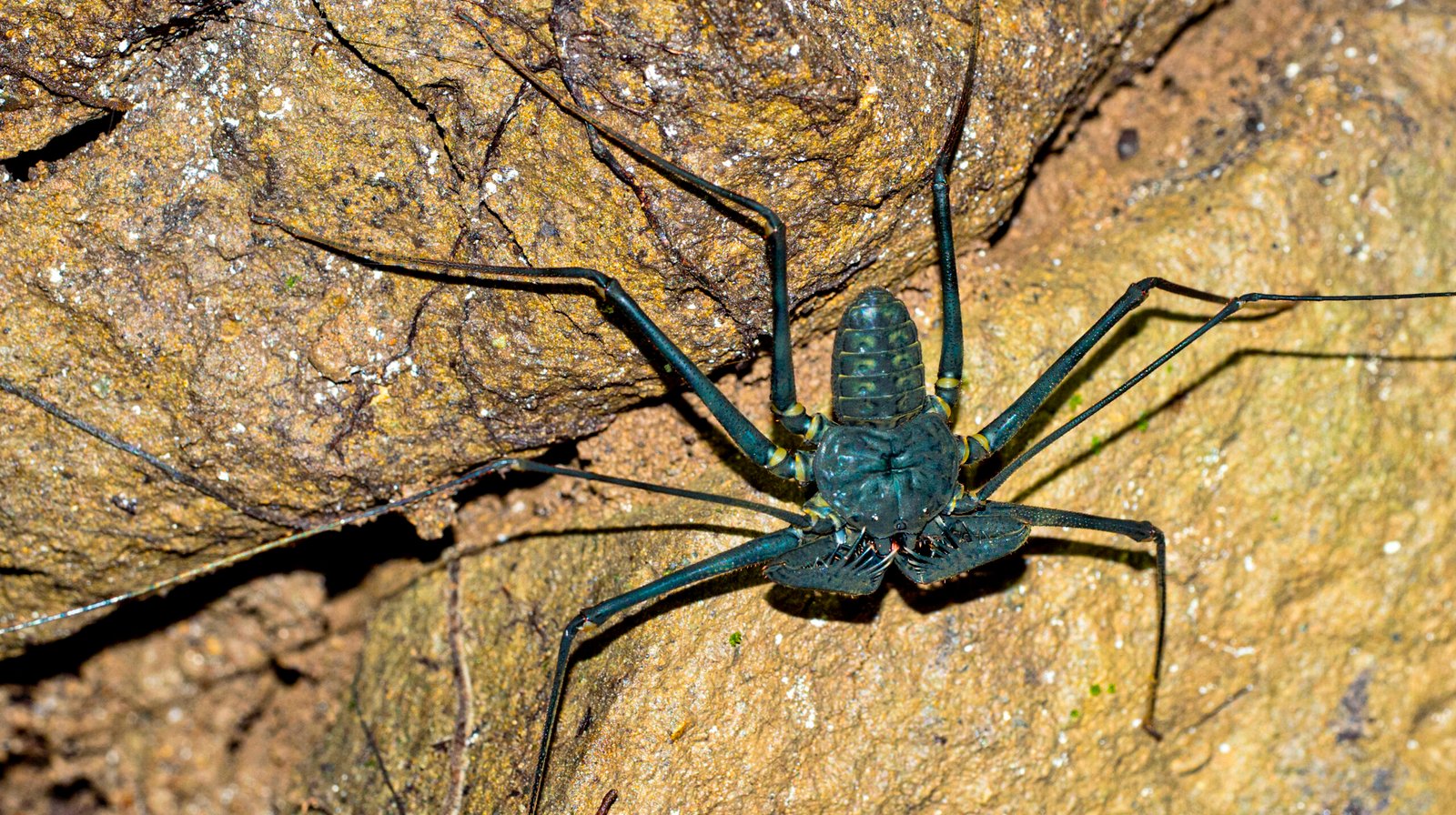
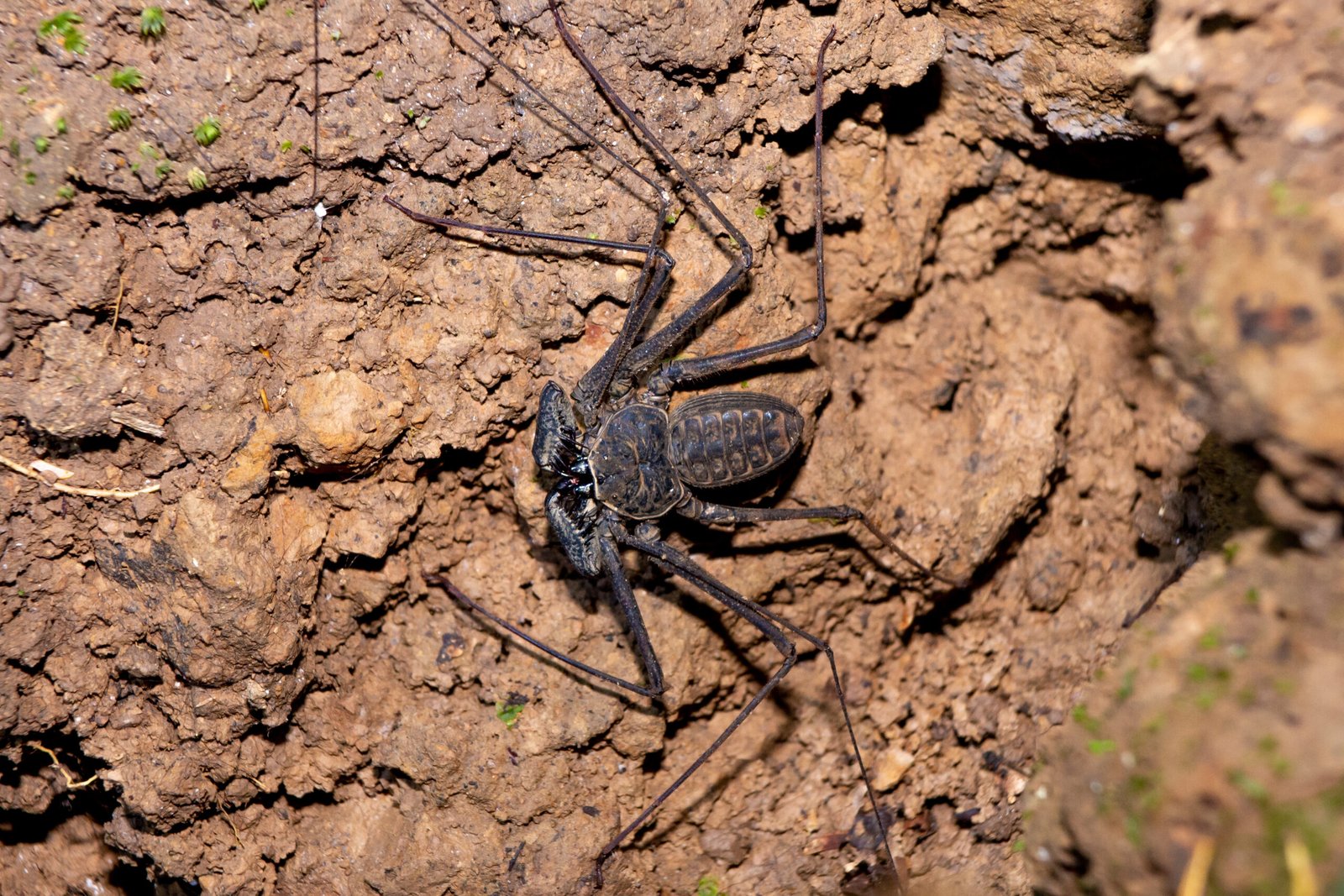
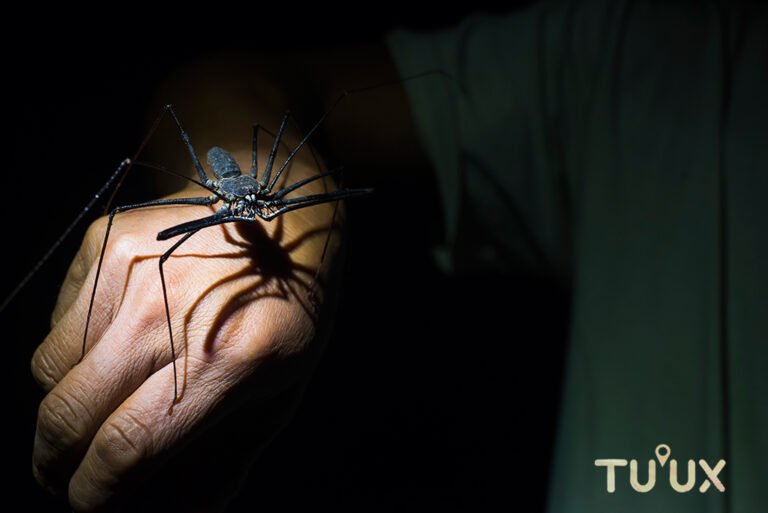
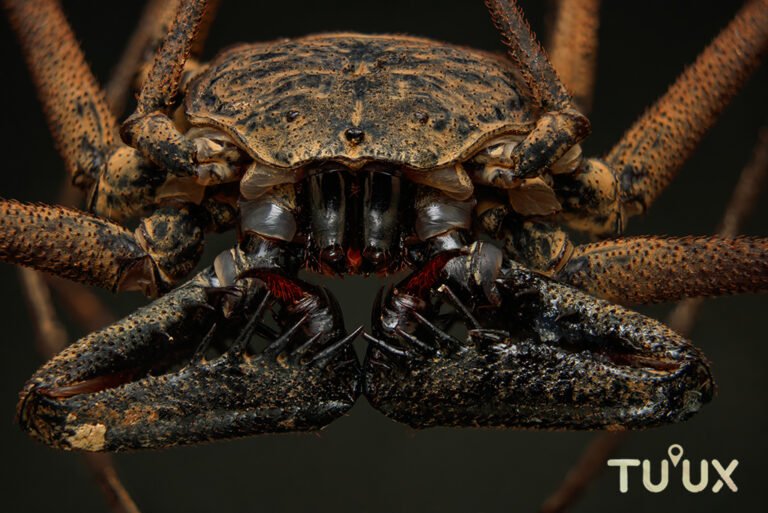
Las dos imágenes de 2026 se incluyen como material ilustrativo y comparativo. Las fotografías TuuxMahahual de 2025 muestran amblipigios, pero no asignamos una especie concreta únicamente a partir de estas imágenes.
The two 2026 photographs are included as comparative illustrative material. The 2025 TuuxMahahual images show amblypygids, but no species-level identification is claimed from photographs alone.
❓ Preguntas frecuentes sobre los amblipigios
¿Qué es un Amblypygi?
Amblypygi es un orden de arácnidos diferente de las arañas y los escorpiones. Sus características más distintivas son los pedipalpos raptoriales y el primer par de patas extremadamente largas utilizadas principalmente como órganos sensoriales.
¿Un amblipigio es una araña?
No. Es un arácnido, pero pertenece a un orden diferente llamado Amblypygi.
¿Los amblipigios tienen veneno?
No poseen glándulas de veneno ni aguijón. Sus pedipalpos espinosos pueden utilizarse defensivamente si el animal es sujetado o molestado.
¿Son peligrosos para las personas?
Representan un riesgo muy bajo. No tienen aguijón ni glándulas de veneno y normalmente intentan escapar. No es recomendable manipularlos porque los pedipalpos pueden producir pequeñas heridas superficiales.
¿Por qué tienen dos patas tan largas?
El primer par de patas está modificado como estructuras anteniformes sensoriales. Contienen numerosos receptores mecánicos y químicos utilizados para explorar y orientarse.
¿Utilizan esas patas largas para caminar?
Principalmente no. La locomoción depende sobre todo de los otros tres pares de patas, mientras el primer par funciona como sistema sensorial.
¿Pueden orientarse en completa oscuridad?
Sí pueden navegar eficazmente con muy poca información visual. Experimentos han demostrado que las patas anteniformes son fundamentales para regresar a un refugio y que las señales químicas también participan en ese proceso.
¿Tienen memoria?
Experimentos de reconocimiento de refugios han encontrado memoria de señales olfativas durante al menos dos semanas en especies estudiadas.
¿Qué comen?
Son depredadores. Pueden alimentarse de grillos, cucarachas, escarabajos y otros artrópodos, aunque la dieta cambia entre especies y hábitats.
¿Son nocturnos?
La gran mayoría de las observaciones corresponden a actividad nocturna. Durante el día normalmente permanecen ocultos en refugios protegidos.
¿Viven en cuevas?
Muchas especies utilizan cuevas y ambientes subterráneos, pero no todos los amblipigios son exclusivamente cavernícolas. También pueden habitar corteza, troncos, grietas, hojarasca y otros microhábitats húmedos.
¿Hay amblipigios en Quintana Roo?
Sí. La literatura científica documenta varias especies de Amblypygi en la Península de Yucatán y Quintana Roo.
¿Qué especies existen en la Península de Yucatán?
Una revisión regional documentó Paraphrynus chacmool, Paraphrynus raptator, Paraphrynus reddelli, Phrynus cozumel y Phrynus parvulus.
¿Qué especie vive en Mahahual?
Existen observaciones de amblipigios en el área, pero no contamos con una revisión taxonómica publicada que permita asignar con seguridad una especie específica a Mahahual únicamente con la información disponible.
¿Las madres cargan a sus crías?
Sí. Después de emerger, las crías suben al dorso de la madre y permanecen allí durante su primera etapa de desarrollo hasta realizar una muda.
¿Son animales sociales?
Algunas especies muestran asociaciones prolongadas entre madres, crías y hermanos e interacciones táctiles tolerantes. No debe generalizarse este comportamiento a todas las especies.
¿Desde cuándo existen?
El registro fósil fiable de Amblypygi llega al Carbonífero tardío, hace al menos aproximadamente 313.7 millones de años.
¿Qué hago si encuentro uno dentro de mi casa?
No es necesario matarlo. Puedes dejarlo continuar o, si realmente necesitas retirarlo, guiarlo cuidadosamente hacia un recipiente sin tocarlo y liberarlo en un sitio cercano protegido y sombreado.
❓ Frequently asked questions
Are whip spiders true spiders?
No. They are arachnids belonging to their own order, Amblypygi.
Are amblypygids venomous?
No. They possess neither a stinger nor venom glands.
Are they dangerous to people?
They pose very little risk. A restrained animal may use its spiny pedipalps defensively, so handling is unnecessary.
What are the long front legs used for?
They are antenniform sensory legs covered with receptors used to gather tactile, mechanical and chemical information.
Are amblypygids found in Quintana Roo?
Yes. Several species are documented from the Yucatán Peninsula and Quintana Roo, although a particular species should not be assigned to Mahahual without diagnostic evidence.
How old is the Amblypygi lineage?
Reliable fossils extend to the Late Carboniferous, more than 300 million years ago.
📚 Fuentes científicas y taxonómicas
- World Arachnida Catalog · Amblypygi de México · 2026 — referencia taxonómica actual del orden.
- Delfín-González et al. · Arachnids of the Yucatán Peninsula — revisión regional que documenta las especies de Amblypygi de Campeche, Quintana Roo y Yucatán.
- World Arachnida Catalog · Phrynus cozumel — especie descrita con localidad tipo en Isla Cozumel, Quintana Roo.
- Systematic Biology · The first global phylogeny of whip spiders · 2024 — evolución y relaciones del orden Amblypygi.
- Journal of Experimental Biology · Importance of antenniform legs for homing — navegación experimental y retorno al refugio.
- Animal Behaviour · Nocturnal navigation by whip spiders — reconocimiento olfativo del refugio y memoria.
- Santer & Hebets · The Sensory and Behavioural Biology of Whip Spiders — sistema sensorial, mecanorrecepción, quimiorrecepción y comportamiento.
- Journal of Arachnology · Social behavior in amblypygids — cuidado maternal, asociaciones familiares y conducta social.
- Novitates Paleoentomologicae · Fossil whip spiders and maternal care — fósiles de Amblypygi y evidencia evolutiva del cuidado maternal.
📚 Scientific and taxonomic sources
- World Arachnida Catalog 2026 — current Amblypygi taxonomy.
- Tropical and Subtropical Agroecosystems — arachnids of the Yucatán Peninsula.
- Systematic Biology 2024 — global molecular phylogeny of whip spiders.
- Journal of Experimental Biology — antenniform legs and homing.
- Animal Behaviour — olfactory shelter recognition and navigation.
- Advances in Insect Physiology — sensory and behavioral biology.
- Journal of Arachnology — social behavior and maternal associations.
- Novitates Paleoentomologicae — fossil record and maternal care.
El amblipigio reúne casi todas las características capaces de activar nuestros prejuicios: muchas patas, movimientos rápidos, grandes espinas y actividad nocturna.
Pero la ciencia cuenta una historia completamente diferente.
Estamos frente a un linaje con más de 300 millones de años de historia, un sofisticado sistema sensorial, extraordinarias capacidades de orientación y comportamientos maternales que pocas personas imaginan cuando lo ven por primera vez.
En la Península de Yucatán, estos animales forman parte de un mundo nocturno que ocurre entre cuevas, grietas, troncos y selva mientras nosotros dormimos.
La próxima vez que aparezca uno en Mahahual, quizá ya no veamos una criatura aterradora. Veremos uno de los sistemas sensoriales más extraordinarios de nuestra fauna tropical.
Whip spiders possess nearly every feature capable of triggering human fear: long legs, rapid movement, spines and nocturnal habits.
Science tells a very different story.
This is an ancient lineage with a remarkable sensory system, sophisticated navigation and surprising maternal behavior.
The next time one appears in Mahahual, we may see not a monster, but one of tropical nature’s most extraordinary sensory specialists.