
TORTUGA CAREY
Mahahual · Caribe Mexicano · Arrecifes · Conservación
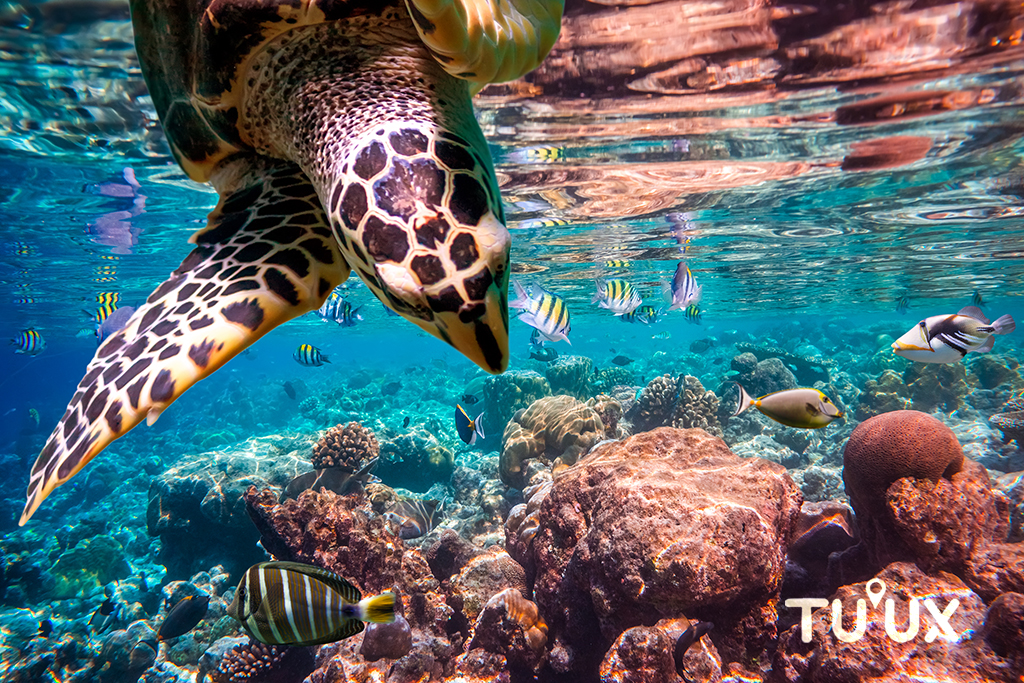
Su pico parece el de un halcón, su caparazón combina tonos ámbar, café, dorado y negro, y su historia está profundamente ligada a los arrecifes tropicales. Conoce a Eretmochelys imbricata, una de las tortugas marinas más extraordinarias y amenazadas del planeta.
Mahahual · Mexican Caribbean · Coral Reefs · Conservation
Its narrow beak resembles that of a hawk, while its shell combines amber, brown, golden and dark patterns. Meet Eretmochelys imbricata, one of the world’s most remarkable and threatened sea turtles.
Entre las grietas y formaciones coralinas frente a Mahahual se desplaza una tortuga cuyo cuerpo parece diseñado específicamente para explorar el arrecife.
Es la tortuga carey, Eretmochelys imbricata, una especie marina pantropical estrechamente relacionada con arrecifes de coral y otros hábitats costeros complejos.
La carey no es solamente una visitante ocasional del Caribe mexicano. Documentos oficiales de manejo ambiental reconocen específicamente la zona de Mahahual como área de interanidación y corredor migratorio utilizado por tortugas marinas, incluida Eretmochelys imbricata.
Among coral formations off Mahahual lives a sea turtle whose anatomy appears almost perfectly designed for exploring reefs.
The hawksbill turtle, Eretmochelys imbricata, is a pantropical species strongly associated with coral reefs and other complex coastal habitats.
Official management documents for the Mexican Caribbean identify the Mahahual area as an internesting and migratory corridor used by hawksbill and other sea turtles.
🔎 Ficha rápida
Eretmochelys imbricata
~60–105 cm
de caparazón
~45–68 kg
en adultos típicos
Madurez aproximada
20–35 años
🔎 Quick facts
Eretmochelys imbricata
~60–105 cm
shell length
~45–68 kg
typical adults
Maturity around
20–35 years
👀 Cómo reconocer una tortuga carey
El pico que le dio su nombre
Su cabeza es relativamente estrecha y termina en un pico largo, puntiagudo y curvado.
Esa forma recuerda al pico de un ave rapaz y permite introducir la cabeza en grietas y pequeños espacios del arrecife.
El caparazón presenta combinaciones de tonos ámbar, amarillo, café, rojizo y negro, creando uno de los patrones más llamativos entre las tortugas marinas.
🐦 Pico pronunciado
Estrecho, puntiagudo y claramente curvado.
🐢 Escudos superpuestos
Los escudos del caparazón se superponen de forma característica, especialmente en individuos jóvenes.
4️⃣ Cuatro pares costales
Presenta cuatro pares de grandes escudos costales a cada lado del caparazón.
👁️ Dos pares prefrontales
Entre los ojos posee dos pares de escamas prefrontales, útiles para distinguirla.
👀 How to identify a hawksbill
Hawksbills have a narrow, pointed, strongly curved beak, overlapping shell scutes, four pairs of costal scutes and two pairs of prefrontal scales.
Their carapace often displays amber, brown, yellow, reddish and dark markings.
🐢 Carey vs. tortuga verde: cómo diferenciarlas
🟤 Tortuga carey
Pico: estrecho y marcadamente curvado.
Caparazón: frecuentemente con escudos superpuestos y borde posterior aserrado.
Escamas entre los ojos: dos pares prefrontales.
🟢 Tortuga verde
Cabeza: más redondeada y hocico menos pronunciado.
Caparazón: escudos generalmente no superpuestos.
Escamas entre los ojos: normalmente un par prefrontal.
🪸 Una especialista de los arrecifes tropicales
La carey habita aguas tropicales y subtropicales de los océanos Atlántico, Pacífico e Índico.
Conforme crece, pasa de una etapa juvenil oceánica a hábitats costeros de alimentación.
Los arrecifes coralinos son particularmente importantes en gran parte de su distribución, aunque también puede utilizar formaciones rocosas, lagunas costeras, estuarios y otros ambientes.
🪸 A specialist of tropical reefs
Hawksbills occur throughout tropical and subtropical regions of the Atlantic, Pacific and Indian oceans.
Coral reefs are especially important feeding and resting habitats, although the species also uses rocky areas, estuaries and other coastal habitats.
🧽 Una tortuga capaz de comer esponjas
La tortuga carey es omnívora, pero en muchos arrecifes del Caribe su dieta puede estar fuertemente dominada por esponjas marinas.
Su pico estrecho permite alcanzar presas dentro de agujeros y grietas inaccesibles para animales con cabezas más anchas.
🧽 Esponjas
Constituyen uno de sus principales alimentos en muchos arrecifes caribeños.
🌿 Algas
También pueden formar parte de la dieta dependiendo de la región.
🐚 Invertebrados
Moluscos, tunicados, crustáceos y erizos pueden consumirse.
🪼 Otros alimentos
Se han documentado también medusas y otros organismos marinos.
🌿 ¿Por qué es importante para el arrecife?
Las esponjas son componentes naturales e importantes de los arrecifes. Sin embargo, también compiten por espacio con otros organismos, incluidos los corales.
La depredación de la tortuga carey puede influir en qué especies de esponjas prosperan y dónde crecen.
Investigaciones de ecología del Caribe sugieren que, históricamente, cuando las poblaciones de carey eran muchísimo mayores, su efecto sobre las comunidades de esponjas pudo haber sido considerable.
🌿 Why does the hawksbill matter to reefs?
Hawksbills are important sponge predators on Caribbean reefs.
Their feeding can influence sponge community structure and therefore ecological interactions involving reef space and other benthic organisms.
🥚 Una vida que conecta playas, océano abierto y arrecifes
La hembra deposita sus huevos en una playa arenosa.
Las crías entran al mar abierto y pueden permanecer varios años asociadas a corrientes y material flotante.
Más adelante ocupa arrecifes y otros hábitats costeros de alimentación.
Tras décadas de crecimiento alcanza la madurez sexual.
🌊 Los primeros años: una pequeña tortuga en un océano enorme
Después de llegar al mar, muchas crías de tortuga carey entran en una etapa oceánica.
Durante aproximadamente uno a cinco años, pueden utilizar zonas asociadas con corrientes, algas flotantes y líneas de deriva.
Cuando alcanzan aproximadamente 20–30 cm de longitud de caparazón, muchas comienzan a incorporarse a hábitats costeros de alimentación.
🌙 El regreso a la playa
Las hembras adultas muestran filopatría natal: tienden a regresar a la región donde nacieron para reproducirse décadas después.
Una hembra no necesariamente anida cada año. Los intervalos pueden ser de aproximadamente uno a cinco años.
🪺 3–5 nidos
Una hembra puede producir varios nidos durante una misma temporada reproductiva.
🥚 130–160 huevos
Es el promedio aproximado reportado por NOAA para cada nido.
⏳ ~2 meses
La incubación suele durar aproximadamente dos meses, con variación ambiental.
🌡️ Temperatura
Influye en el desarrollo embrionario y en la proporción de sexos.
🌡️ La arena también determina el futuro de la población
Como otras tortugas marinas, la carey presenta determinación sexual dependiente de la temperatura.
Las condiciones térmicas durante una etapa crítica del desarrollo embrionario influyen en la proporción de machos y hembras.
El calentamiento de las playas puede producir proporciones de sexos muy sesgadas y temperaturas extremas también pueden reducir el éxito de incubación.
📍 La tortuga carey en Mahahual
La relación entre la carey y Mahahual está respaldada por documentación oficial.
El Programa de Manejo de la Reserva de la Biosfera Caribe Mexicano señala que las aguas de esta zona funcionan como área de interanidación y corredor migratorio para varias especies de tortuga marina.
Entre ellas se menciona expresamente a Eretmochelys imbricata.
📍 Hawksbills in Mahahual
Official management documents for the Mexican Caribbean identify Mahahual waters as an internesting and migratory corridor for several sea turtle species, including Eretmochelys imbricata.
🚨 ¿Qué tan amenazada está?
México mantiene además una veda permanente para la captura de tortugas marinas desde 1990.
📈 ¿Hay señales de recuperación?
Sí, pero la historia es compleja.
La Península de Yucatán ha sido históricamente una de las regiones más importantes del Atlántico para la anidación de tortuga carey.
A comienzos de los años 2000 se documentó una fuerte disminución de nidos en la región.
Sin embargo, después de 2007 varias playas comenzaron a mostrar tendencias positivas. Algunas zonas, como Holbox y Chenkan, llegaron incluso a registrar niveles históricamente altos durante ciertos periodos de monitoreo.
💔 El caparazón que casi la condenó
Durante siglos, el caparazón de la carey fue utilizado para fabricar joyería, peines, cajas, adornos, incrustaciones y otros objetos.
Ese material fue conocido internacionalmente como tortoiseshell o carey.
La demanda comercial internacional contribuyó enormemente al colapso histórico de numerosas poblaciones.
⚠️ Las amenazas actuales
🕸️ Captura incidental
Redes, anzuelos y otros artes de pesca pueden atraparlas, lesionarlas o causar ahogamiento.
🪸 Degradación del arrecife
La pérdida de hábitat coralino reduce refugios y zonas de alimentación.
🏖️ Desarrollo costero
Construcción, modificación de playas y pérdida de vegetación alteran sitios reproductivos.
💡 Luz artificial
Puede desorientar crías y alterar el comportamiento de hembras en playas.
🧴 Contaminación
Plásticos, residuos y contaminación marina generan riesgo de ingestión y enredo.
🚤 Embarcaciones
Colisiones pueden provocar lesiones graves o mortalidad.
🐢 Comercio ilegal
El caparazón continúa siendo comercializado clandestinamente en algunas regiones.
🌡️ Cambio climático
Afecta temperaturas de incubación, playas, arrecifes, tormentas y nivel del mar.
💡 Una amenaza especialmente importante en la costa: la luz
Las crías que emergen durante la noche utilizan señales visuales del horizonte para orientarse hacia el océano.
En una playa natural, el horizonte marino suele ofrecer una referencia luminosa diferente a la vegetación y las dunas.
Hoteles, casas, calles y luminarias pueden modificar por completo esas señales.
🤿 Si encuentras una carey haciendo snorkel
🌙 Si encuentras una tortuga en la playa
🛡️ Conservación local en Mahahual
Proteger tortugas marinas requiere mucho más que vigilar una playa durante la temporada reproductiva.
También significa proteger arrecifes, mantener corredores marinos, reducir contaminación, manejar correctamente la iluminación costera y promover un turismo responsable.
Para conocer iniciativas locales, reportar observaciones o solicitar orientación en Mahahual, puedes consultar a Proyecto AAk Mahahual A.C.
Conservación, educación ambiental y trabajo comunitario en la región de Mahahual.
Conocer Proyecto AAk →🛡️ Local conservation in Mahahual
Sea turtle conservation requires protecting reefs, beaches, migration corridors and water quality, while also reducing artificial lighting and human disturbance.
Learn about local conservation and environmental education initiatives in Mahahual.
Proyecto AAk Mahahual →📷 Galería · Tortugas marinas
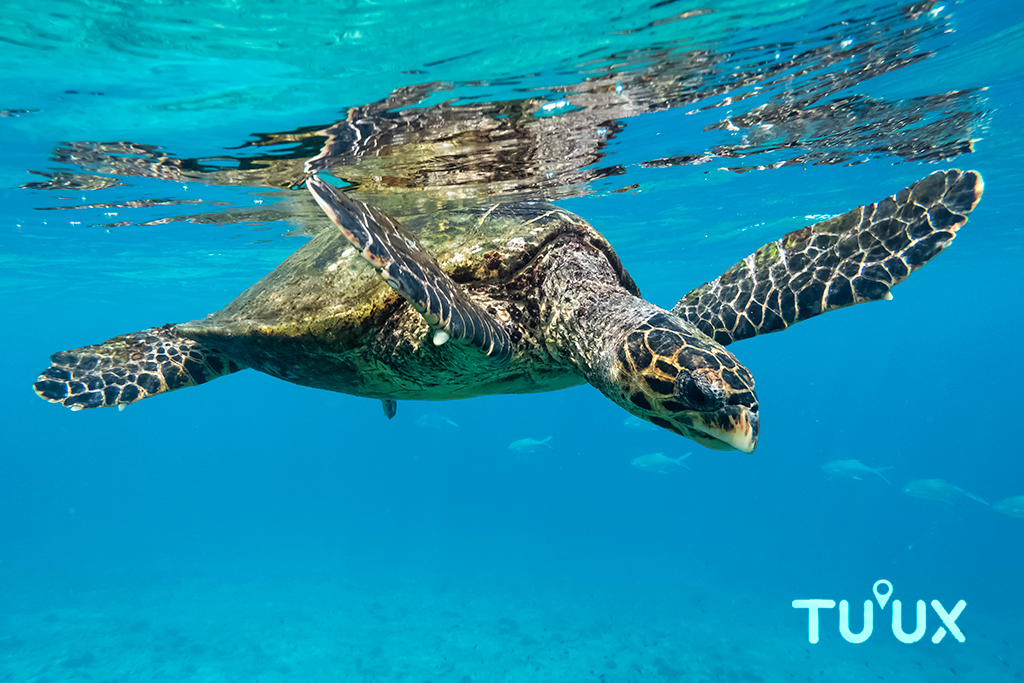
La identificación de una tortuga marina debe considerar cabeza, escamas, forma del pico, distribución de los escudos y características del caparazón.
📷 Gallery · Sea turtles
Reliable sea turtle identification uses head shape, facial scales, beak shape and carapace scute patterns.
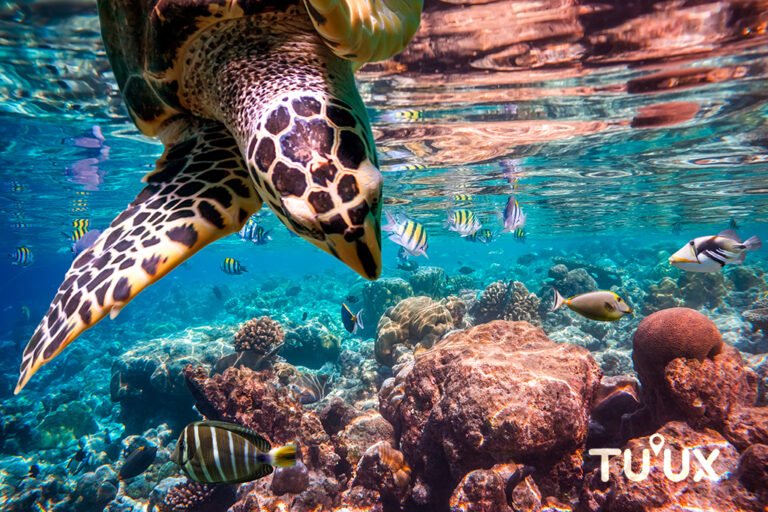
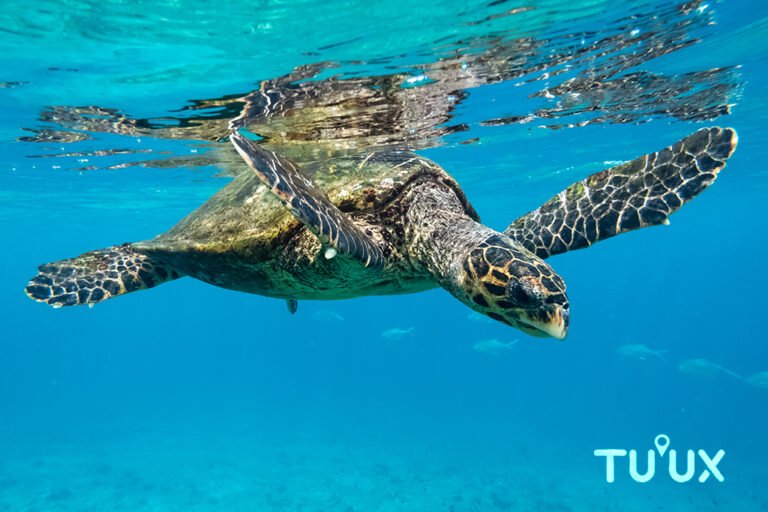
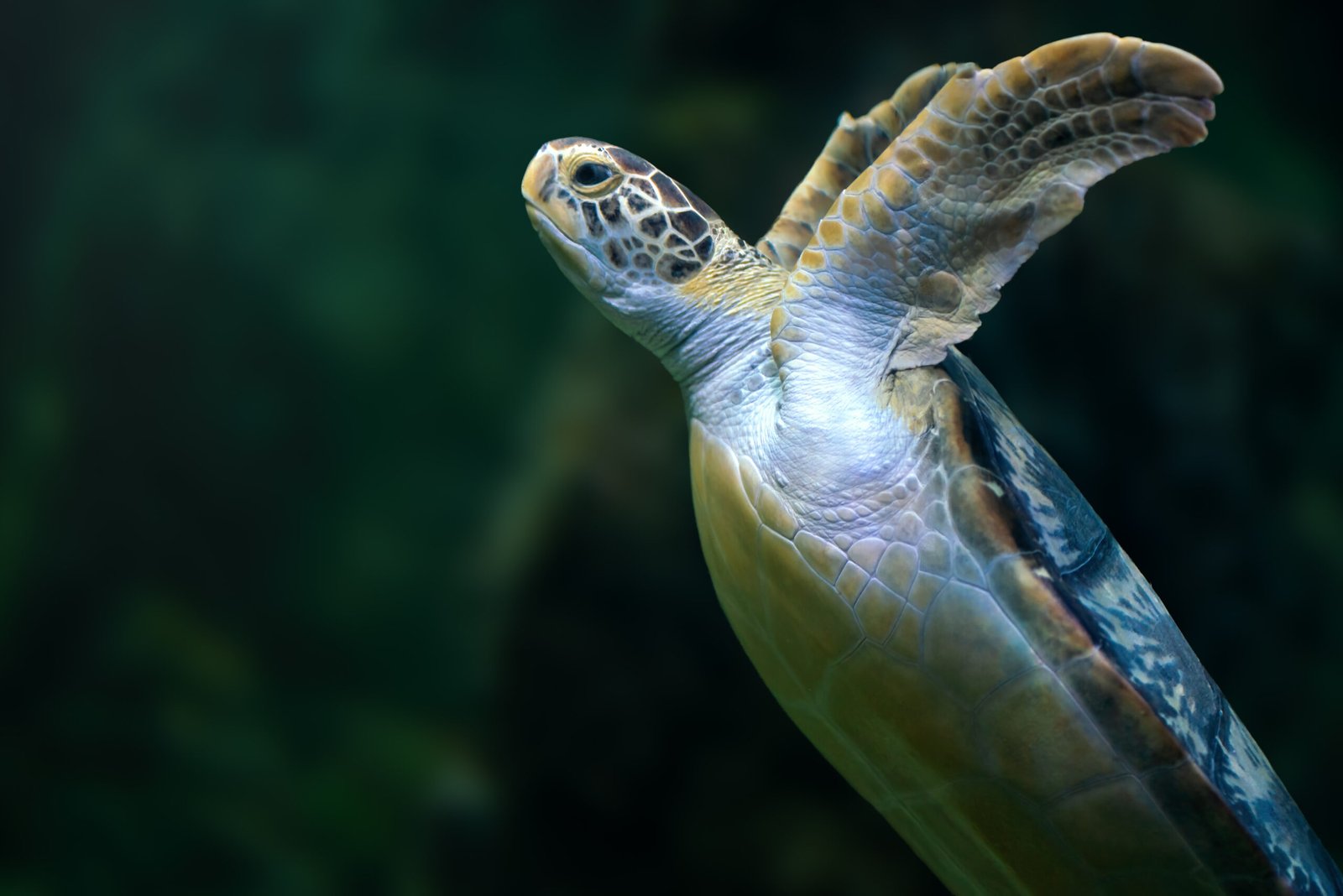
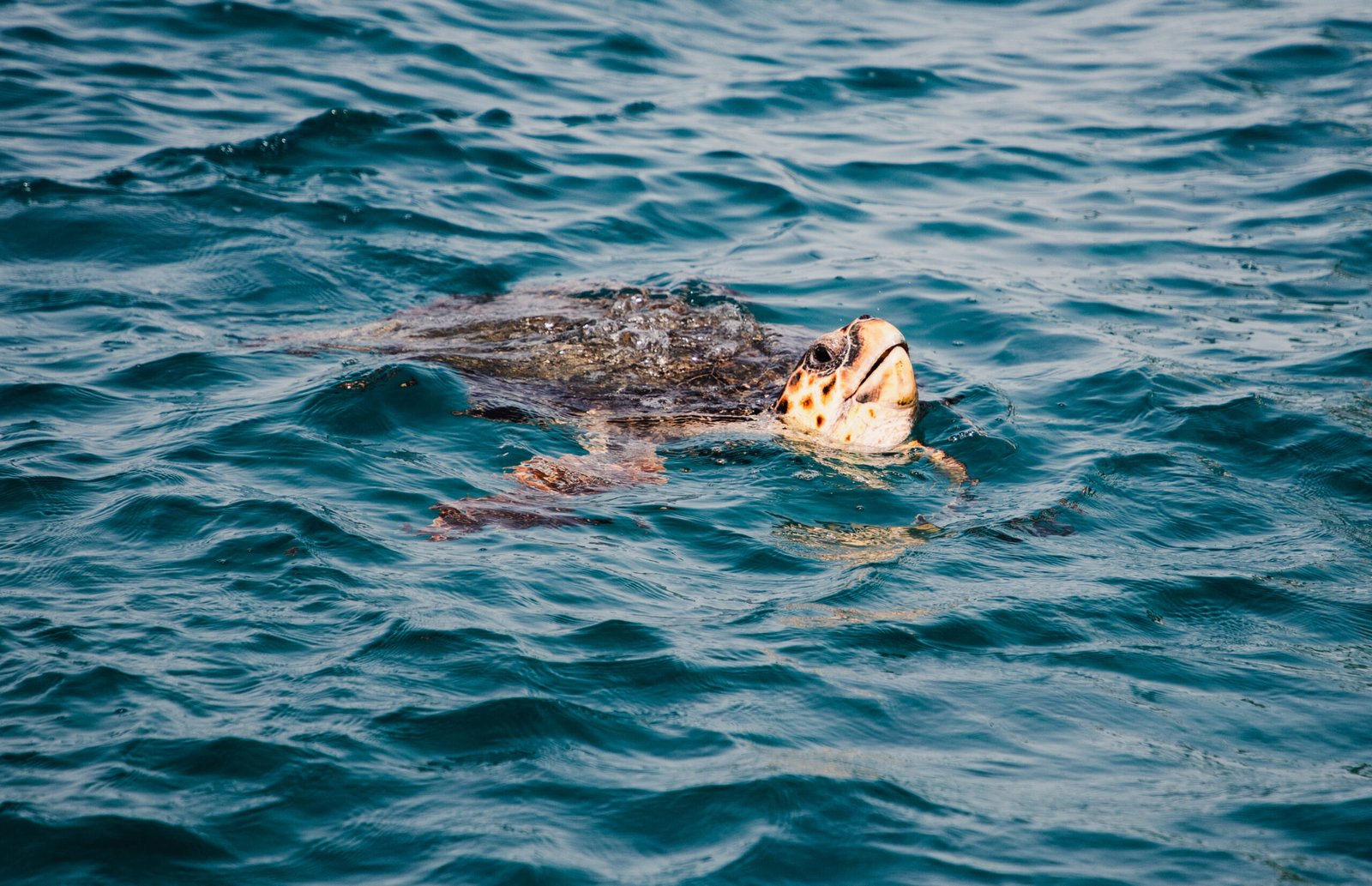
Nota: las dos últimas fotografías se presentan como imágenes ilustrativas de tortugas marinas. Sin caracteres diagnósticos suficientes no asignamos una especie únicamente por el nombre del archivo.
Note: the final two photographs are presented as illustrative sea turtle images. Species identification should not be assigned without sufficient diagnostic characters.
❓ Preguntas frecuentes
¿Hay tortuga carey en Mahahual?
Sí. El Programa de Manejo de la Reserva de la Biosfera Caribe Mexicano identifica la zona de Mahahual como área de interanidación y corredor migratorio utilizado por tortugas marinas y menciona específicamente a la tortuga carey, Eretmochelys imbricata.
¿Cómo puedo reconocer una tortuga carey?
Presenta una cabeza estrecha con pico puntiagudo y curvado, dos pares de escamas prefrontales, cuatro pares de escudos costales y un caparazón frecuentemente caracterizado por escudos superpuestos y patrones ámbar, cafés, amarillos y oscuros.
¿Qué come la tortuga carey?
Es omnívora, pero en muchos arrecifes del Caribe su alimentación está fuertemente asociada con esponjas marinas. También puede consumir algas, tunicados, moluscos, crustáceos, erizos, medusas y otros organismos.
¿Por qué la tortuga carey es importante para los arrecifes?
Al consumir esponjas puede influir en la estructura de las comunidades de esponjas del arrecife. Esto forma parte de una red compleja de interacciones entre esponjas, corales, peces y otros organismos.
¿Cuánto vive una tortuga carey?
Su longevidad exacta en libertad no se conoce con precisión. Las estimaciones actuales sugieren aproximadamente 50 años o más.
¿A qué edad se reproduce?
NOAA estima que la madurez sexual puede alcanzarse aproximadamente entre los 20 y 35 años, aunque existe variación entre poblaciones y condiciones ambientales.
¿Cuántos huevos pone?
Una hembra puede realizar aproximadamente tres a cinco nidos durante una temporada reproductiva, con un promedio aproximado de 130 a 160 huevos por nido.
¿La temperatura determina el sexo de las crías?
Sí. Como en otras tortugas marinas, la temperatura de incubación influye en la proporción sexual de las crías. Por ello, el calentamiento de las playas representa una preocupación adicional frente al cambio climático.
¿La tortuga carey está en peligro de extinción?
Sí. Globalmente continúa tratándose como En Peligro Crítico. En México está incluida en la categoría En peligro de extinción de la NOM-059-SEMARNAT-2010.
¿Se puede comprar artesanía hecha con carey?
No debe comprarse ningún producto fabricado con caparazón de tortuga carey. La especie está incluida en el Apéndice I de CITES y el comercio ilegal de su caparazón sigue siendo una amenaza importante.
¿Puedo tocar una tortuga mientras hago snorkel?
No. Debe mantenerse una distancia respetuosa, sin tocarla, perseguirla, alimentarla ni bloquear su camino hacia la superficie.
¿Qué hago si encuentro una tortuga anidando?
Mantén distancia, guarda silencio, evita flash y luces directas, no manipules a la tortuga, huevos o crías, y sigue las indicaciones de los programas y autoridades locales.
¿Las poblaciones están recuperándose?
La situación varía por región. Algunas playas de la Península de Yucatán mostraron tendencias positivas después de 2007, lo que demuestra que la conservación puede generar resultados. Sin embargo, la especie sigue enfrentando una situación global de conservación crítica.
❓ Frequently asked questions
Are hawksbill turtles found in Mahahual?
Yes. Official management documents identify Mahahual as an internesting and migratory corridor used by hawksbill and other sea turtles.
How can I identify a hawksbill turtle?
Look for a narrow curved beak, two pairs of prefrontal scales, four pairs of costal scutes and overlapping shell scutes.
What do hawksbill turtles eat?
Sponges dominate the diet in many Caribbean populations, although hawksbills also consume algae and various marine invertebrates.
Are hawksbill turtles Critically Endangered?
The species continues to be treated globally as Critically Endangered. It is also listed in CITES Appendix I and receives strict legal protection in Mexico.
Can I touch a hawksbill while snorkeling?
No. Observe from a respectful distance without touching, chasing, feeding or blocking the animal.
📚 Fuentes y referencias
- NOAA Fisheries · Hawksbill Turtle — identificación, distribución, dieta, hábitat, reproducción, longevidad y amenazas.
- CONANP · PACE Tortuga Carey — estrategia mexicana de conservación de Eretmochelys imbricata.
- CONANP · Programa de Manejo Reserva de la Biosfera Caribe Mexicano — presencia de tortuga carey en Mahahual, corredor migratorio, interanidación e iluminación costera.
- PROFEPA · Protección de las tortugas marinas en México — protección legal, NOM-059 y veda nacional.
- CITES · Eretmochelys imbricata — Apéndice I, comercio, amenazas y estado global.
- PeerJ · Ecology of Caribbean sponges — papel ecológico de la depredación por tortugas carey sobre comunidades de esponjas.
- Ecology and Evolution · Hawksbill nesting & climate — temperatura, determinación sexual y cambio climático.
- Regional Studies in Marine Science · Yucatán nesting — historia y tendencias de anidación de tortuga carey en la Península de Yucatán.
- Proyecto AAk Mahahual A.C. — iniciativa local de conservación y educación ambiental.
📚 Sources & references
- NOAA Fisheries — hawksbill identification, life history, diet and threats.
- CONANP — Mexican Hawksbill Turtle Species Conservation Action Program.
- Mexican Caribbean Biosphere Reserve Management Program — hawksbill occurrence and sea turtle corridors around Mahahual.
- PROFEPA — legal protection of sea turtles in Mexico.
- CITES — international protection and Appendix I status.
- PeerJ — hawksbill predation and Caribbean sponge ecology.
- Ecology and Evolution — nest temperature and climate change.
Una tortuga carey puede tardar décadas en llegar a la edad reproductiva.
Durante ese tiempo habrá atravesado océano abierto, corrientes, arrecifes y posiblemente fronteras entre países.
Su supervivencia depende de que todos esos lugares continúen funcionando.
Necesita playas suficientemente oscuras para reproducirse, mares libres de artes de pesca peligrosos, arrecifes capaces de alimentarla y corredores costeros donde pueda desplazarse.
Saber que la tortuga carey utiliza las aguas de Mahahual convierte su conservación en algo mucho más cercano: proteger el arrecife que tenemos frente a nosotros también significa proteger una parte de su viaje.
A hawksbill turtle may spend decades reaching reproductive age.
During that lifetime it can move through open ocean, coral reefs and waters belonging to different nations.
Its survival depends on all of those habitats remaining connected and functional.
Protecting the reef in front of Mahahual means protecting one part of the extraordinary journey of the hawksbill turtle.