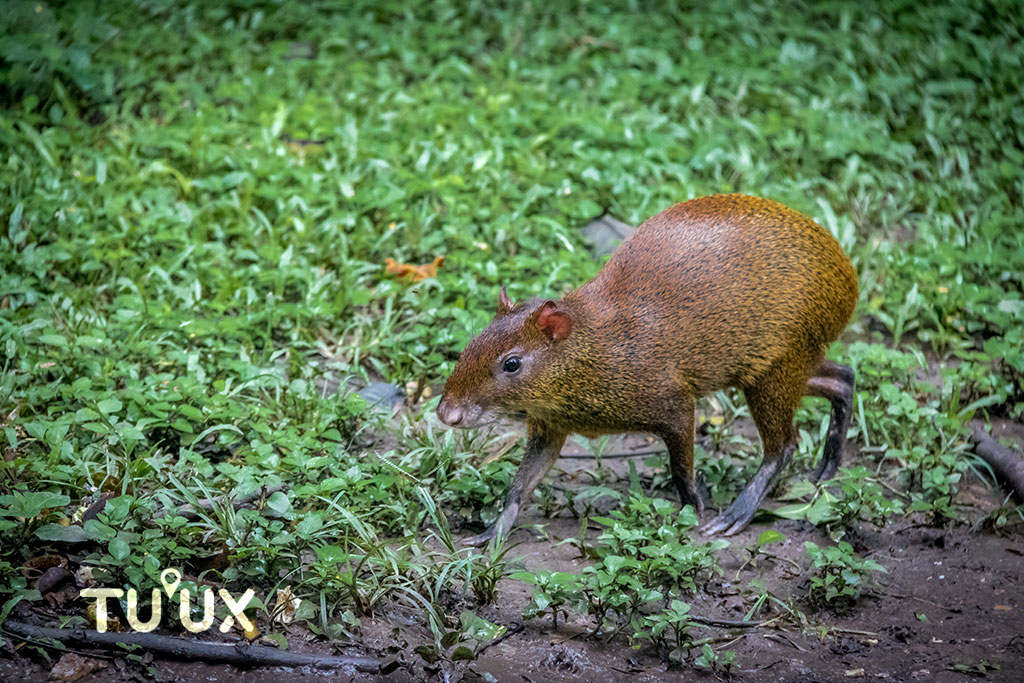
SEREQUE
Mahahual · Costa Maya · Selva Maya · Mamíferos
El sereque (Dasyprocta punctata) es mucho más que un pequeño mamífero corriendo entre la hojarasca. Su costumbre de transportar y esconder semillas lo convierte en uno de los grandes aliados para la regeneración de los bosques tropicales.
Mahahual · Costa Maya · Maya Forest · Mammals
The Central American Agouti (Dasyprocta punctata) is much more than a small mammal running through leaf litter. By transporting and hiding seeds, it becomes an important ally in tropical forest regeneration.
A veces basta con escuchar un crujido entre las hojas para descubrir que no estamos solos. Una silueta café rojiza cruza rápidamente entre arbustos, se detiene unos segundos, toma un fruto y vuelve a desaparecer.
Es el sereque, nombre con el que en la Península de Yucatán se conoce al agutí centroamericano, Dasyprocta punctata.
Pertenece a la familia Dasyproctidae y es uno de los roedores terrestres más característicos de los bosques tropicales de Mesoamérica.
Su presencia en la Península de Yucatán está ampliamente documentada, y Quintana Roo forma parte de su distribución natural.
Sometimes a single crunch in the leaf litter is enough to reveal that we are not alone.
A reddish-brown silhouette runs between shrubs, stops briefly, picks up a fruit and disappears again.
This is Dasyprocta punctata, the Central American Agouti, known locally in the Yucatán Peninsula as the sereque.
It belongs to the family Dasyproctidae and is characteristic of tropical forests throughout Mesoamerica.
🔎 Ficha rápida
Dasyprocta punctata
Aproximadamente
2–4 kg
Principalmente
diurno
Especialista en
frutos y semillas
🔎 Quick facts
Dasyprocta punctata
Approximately
2–4 kg
Mainly
diurnal
Fruit & seed
specialist
🐾 ¿Qué es un sereque?
Dasyprocta punctata
El sereque es un roedor terrestre de tamaño mediano, cuerpo compacto, patas delgadas y extremidades posteriores notablemente más largas que las delanteras.
Su pelaje suele variar entre tonos pardos, rojizos, amarillentos y anaranjados, con una textura áspera y brillante que funciona muy bien como camuflaje entre hojas secas.
La cola es extremadamente corta, hasta el punto de resultar prácticamente invisible a distancia.
Sus incisivos fuertes le permiten manipular frutos y abrir semillas de cáscara dura.
🐾 What is an agouti?
Dasyprocta punctata
The Central American Agouti is a medium-sized terrestrial rodent with a compact body, slender legs and hind limbs longer than the front limbs.
Its coarse, glossy coat ranges from brown to reddish, orange and yellowish tones.
The tail is extremely short, while powerful incisors help it process hard fruits and seeds.
📝 Sereque, agutí y Tsuub
Una misma especie puede recibir numerosos nombres dependiendo de la comunidad y el país.
En buena parte de la Península de Yucatán es frecuente escuchar el nombre sereque. También se utiliza agutí o agutí centroamericano.
📝 Many names for the same animal
Throughout its range, Dasyprocta punctata has many regional names.
In the Yucatán Peninsula the Spanish name sereque is widely used, while Central American Agouti is the standard English name.
Regional sources also record the Maya name Tsuub.
🧬 Una actualización científica en 2026
La taxonomía de los agutíes continúa refinándose conforme aparecen nuevos análisis morfológicos y genéticos.
En julio de 2026, Mammal Diversity Database incorporó una actualización basada en nueva investigación: el llamado agutí de la isla de Roatán, Dasyprocta ruatanica, dejó de ser tratado como una especie independiente y pasó a considerarse parte de Dasyprocta punctata.
🧬 A 2026 taxonomic update
Agouti taxonomy continues to change as new morphological and genetic evidence becomes available.
In 2026, Mammal Diversity Database incorporated research supporting the synonymy of the Roatán Island agouti, formerly Dasyprocta ruatanica, under Dasyprocta punctata.
🌰 El jardinero que siembra sin saberlo
Una despensa bajo tierra puede convertirse en bosque
Cuando encuentra una temporada abundante de frutos y semillas, el sereque no necesariamente consume todo inmediatamente.
Transporta algunas semillas lejos del árbol y las entierra individualmente en pequeños escondites. Este comportamiento se conoce como scatter hoarding o almacenamiento disperso.
La intención es regresar y recuperar ese alimento cuando sea necesario. Pero algunas semillas no son recuperadas.
Si las condiciones son adecuadas, pueden germinar y convertirse en nuevas plantas lejos del árbol madre.
Estos experimentos demuestran que el trabajo ecológico del sereque puede ser mucho más complejo que simplemente “enterrar una semilla y olvidarla”.
Los escondites también pueden ser robados por otros agutíes, provocando que las semillas sean trasladadas una y otra vez.
🌰 The gardener that plants without knowing it
A food cache can eventually become a tree
During periods of abundant fruit, agoutis carry seeds away from parent trees and bury them in separate caches.
This behavior, known as scatter hoarding, stores food for future use.
Some seeds are never recovered and can germinate away from the parent plant.
Radio-tracking experiments also revealed that seeds can be stolen, moved and buried repeatedly by different agoutis.
🪴 Enterrar una semilla también puede protegerla
Los pequeños escondites tienen beneficios para el sereque, pero también pueden beneficiar a ciertas plantas.
Experimentos con semillas enterradas de manera similar a los escondites de los agutíes han encontrado que el entierro puede reducir la depredación y el ataque de algunos invertebrados.
En varias especies de plantas tropicales, este proceso aumentó la supervivencia de las semillas y favoreció la germinación o el crecimiento inicial.
🪴 A buried seed may also gain protection
Experimental studies simulating agouti caches found that burial can protect some tropical seeds from predators and insect damage.
For several plant species, caching can improve survival, germination and early seedling growth.
The effect, however, varies among plant species and environmental conditions.
🥭 ¿Qué come el sereque?
Su alimentación gira principalmente alrededor de recursos vegetales.
🥭 Frutos
Los frutos caídos son uno de sus principales recursos alimenticios.
🌰 Semillas
Puede romper cubiertas muy duras gracias a sus poderosos incisivos.
🌱 Material vegetal
Dependiendo de la disponibilidad, puede consumir otras partes de plantas.
🍄 Otros recursos
Se han documentado hongos y ocasionalmente pequeños invertebrados dentro de su dieta.
🥭 What does an agouti eat?
Fruit and seeds make up an important portion of its diet.
Strong incisors allow it to process hard-coated seeds. Other plant material, fungi and occasional animal matter may also be consumed.
🤲 Come casi como si tuviera manos
Una de las escenas más características del sereque ocurre durante la alimentación.
Puede sentarse sobre las patas traseras, sujetar un fruto entre las extremidades delanteras y girarlo mientras utiliza los incisivos para retirar la cubierta.
Esta habilidad le permite manejar alimentos grandes y resistentes con enorme precisión.
🤲 Eating almost as if it had hands
Agoutis often sit on their hind legs while holding food between the forepaws.
The fruit can be rotated while powerful incisors remove its outer layers or crack hard structures.
🌿 ¿Dónde vive?
La distribución actualmente reconocida de Dasyprocta punctata comienza en Chiapas y la Península de Yucatán y continúa por gran parte de Centroamérica y regiones de Sudamérica.
Es un mamífero principalmente terrestre asociado con bosques tropicales, vegetación secundaria y ambientes donde existe suficiente cobertura y disponibilidad de alimento.
🌳 Selva
El sotobosque proporciona alimento, sombra y refugio.
🍂 Hojarasca
En el suelo busca frutos, semillas y sitios donde esconderlos.
💧 Cenotes
Estudios con cámaras trampa en la Península de Yucatán también lo han registrado utilizando ambientes asociados a cenotes.
🌿 Vegetación secundaria
Puede aprovechar mosaicos de vegetación siempre que existan cobertura y alimento.
🌿 Where does it live?
The currently recognized range of Dasyprocta punctata extends from Chiapas and the Yucatán Peninsula south through much of Central America and parts of South America.
It is primarily terrestrial and uses tropical forest, secondary vegetation and other habitats with adequate cover and food resources.
☀️ Un habitante principalmente diurno
A diferencia de muchos mamíferos tropicales, el sereque desarrolla buena parte de su actividad durante el día.
Puede comenzar a moverse temprano en busca de alimento y volver a sus refugios cuando detecta peligro o durante las horas menos favorables.
La actividad puede variar según temperatura, disponibilidad de frutos, perturbación humana y presión de depredadores.
☀️ Mainly active during daylight
Unlike many tropical mammals, Central American Agoutis carry out much of their activity during daylight hours.
Their schedule can vary with temperature, fruit availability, disturbance and predation risk.
💨 Mucho más activo de lo que parece
Aunque muchas veces lo vemos quieto mordiendo un fruto, el sereque puede desplazarse considerablemente a lo largo del día.
Un estudio con individuos rastreados en Panamá encontró desplazamientos diarios promedio cercanos a 850 metros.
Los territorios estudiados ocupaban aproximadamente entre uno y dos hectáreas por individuo, aunque estas cifras pueden variar entre regiones y ambientes.
💨 More active than it looks
Tracking studies in Panama found average daily movements of approximately 850 meters among monitored agoutis.
These movements help explain their potential influence on seed transport throughout the forest.
🍼 Reproducción y crías
El sereque puede reproducirse durante diferentes momentos del año, aunque la disponibilidad de frutos influye fuertemente en el éxito reproductivo.
La gestación dura alrededor de tres a cuatro meses.
Lo más habitual es una camada pequeña, frecuentemente de alrededor de dos crías.
🍼 Reproduction and young
Central American Agoutis can reproduce throughout the year, with fruit availability influencing reproductive success.
Gestation lasts roughly three to four months and litters are usually small.
Young are precocial: they are born furred, with open eyes and can move soon after birth.
🐆 También forma parte del menú de la selva
El sereque es dispersor de semillas y consumidor de frutos, pero también forma parte de la red alimentaria como presa.
Felinos silvestres, grandes serpientes y otros depredadores pueden aprovecharlo como fuente de alimento.
Estudios sobre comunidades de mamíferos en la Península de Yucatán también lo consideran una presa potencial para grandes y medianos carnívoros.
🐆 It is also part of the forest menu
Agoutis disperse seeds and consume fruit, but they are also prey within tropical food webs.
Wild cats, large snakes and other predators may feed on them.
🌱 Conservación
A escala global, Dasyprocta punctata está actualmente clasificado como Preocupación Menor (LC).
Esto significa que la especie mantiene una distribución amplia y no enfrenta actualmente un riesgo global elevado de extinción.
Sin embargo, la situación local puede ser diferente. La pérdida y fragmentación del bosque, la cacería y las carreteras pueden reducir poblaciones en determinadas regiones.
🌱 Conservation
Dasyprocta punctata is currently classified globally as Least Concern.
Local populations, however, may still be affected by forest loss, fragmentation, hunting and road mortality.
👀 Cómo observar un sereque sin molestarlo
👀 How to watch an agouti responsibly
📷 Galería · Sereque de la Costa Maya
Su cuerpo compacto, las patas delgadas, el pelaje rojizo y esa característica cola casi inexistente hacen del sereque uno de los mamíferos más reconocibles de la selva peninsular.
📷 Gallery · Central American Agouti
Its compact body, slender legs, reddish coat and almost invisible tail make the agouti one of the distinctive mammals of the Yucatán Peninsula.
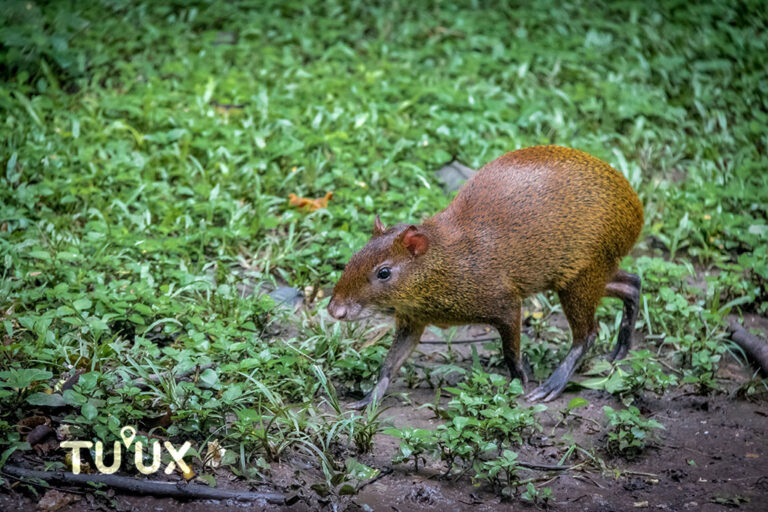
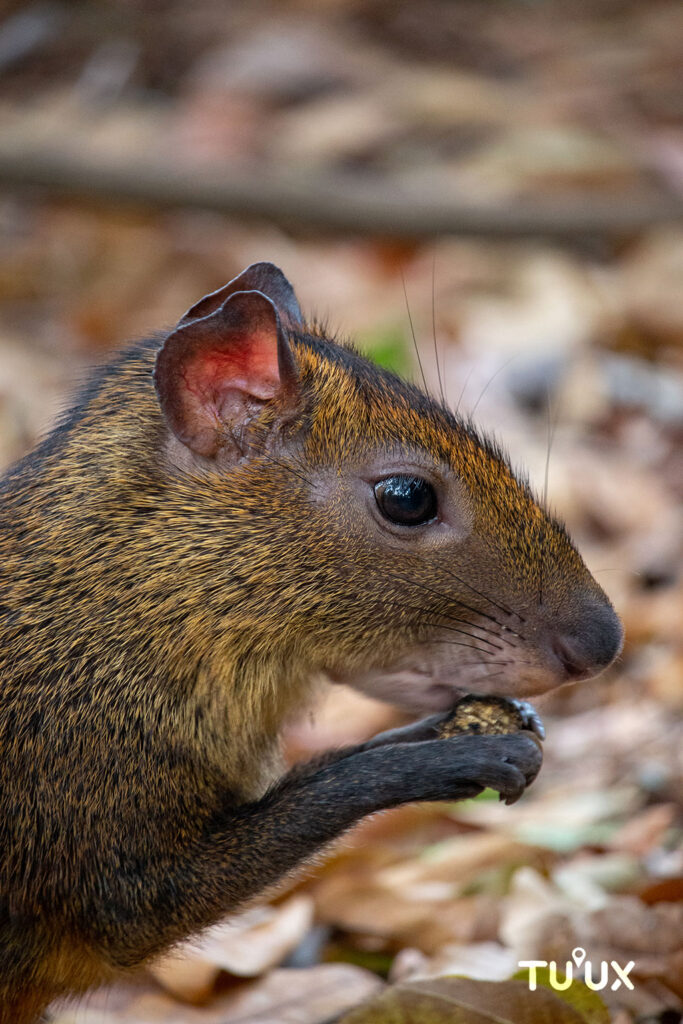
Sereque o agutí centroamericano (Dasyprocta punctata). Obsérvalo siempre a distancia y evita ofrecerle alimento.
Central American Agouti (Dasyprocta punctata). Always observe wildlife from a respectful distance and do not feed it.
❓ Preguntas frecuentes
¿Qué es un sereque?
En la Península de Yucatán, sereque es uno de los nombres comunes utilizados para Dasyprocta punctata, el agutí centroamericano, un roedor terrestre de la familia Dasyproctidae.
¿Hay sereques en la Península de Yucatán?
Sí. La distribución reconocida actualmente de Dasyprocta punctata incluye Chiapas y la Península de Yucatán, además de buena parte de Centroamérica y regiones de Sudamérica.
¿Por qué llaman al sereque jardinero de la selva?
Porque transporta y entierra semillas para consumirlas después. Algunas no son recuperadas y pueden germinar, ayudando a dispersar plantas lejos del árbol madre.
¿Qué come el sereque?
Principalmente frutos y semillas. También puede consumir otras partes vegetales, hongos y ocasionalmente otros recursos disponibles.
¿El sereque es una ardilla?
No. Aunque ambos son roedores, los sereques pertenecen a la familia Dasyproctidae, mientras que las ardillas pertenecen a Sciuridae.
¿El sereque tiene cola?
Sí, pero es extremadamente corta y en muchas observaciones parece prácticamente inexistente.
¿El sereque es nocturno?
El agutí centroamericano es principalmente diurno, aunque sus horarios pueden cambiar según las condiciones ambientales, alimento, perturbación y riesgo de depredación.
¿Está en peligro de extinción?
A escala global, Dasyprocta punctata está actualmente clasificado como Preocupación Menor. Las poblaciones locales, sin embargo, pueden verse afectadas por pérdida de hábitat, cacería y fragmentación del bosque.
¿Debo alimentar a un sereque si aparece cerca de casa?
No. Lo mejor es permitir que la fauna silvestre encuentre sus propios alimentos naturales. Alimentarla puede modificar su comportamiento y hacer que pierda su distancia natural frente a las personas.
❓ Frequently asked questions
What is a sereque?
Sereque is a regional Spanish name used in the Yucatán Peninsula for the Central American Agouti, Dasyprocta punctata.
Is Dasyprocta punctata found in the Yucatán Peninsula?
Yes. Its currently recognized distribution includes Chiapas and the Yucatán Peninsula and extends south through Central America.
Why are agoutis called forest gardeners?
Agoutis transport and bury seeds as food reserves. Seeds that are not recovered may germinate, helping disperse plants away from parent trees.
What do Central American Agoutis eat?
Their diet consists mainly of fruits and seeds, supplemented by other available food resources.
Are agoutis endangered?
Dasyprocta punctata is currently classified globally as Least Concern. Local populations can still be affected by habitat loss, hunting and fragmentation.
📚 Fuentes y referencias
- Mammal Diversity Database · Dasyprocta punctata — taxonomía actual, distribución, sinonimias y estado de conservación.
- Mammal Diversity Database v2.5 · 2026 — actualización taxonómica que incorpora Dasyprocta ruatanica dentro de D. punctata.
- Smithsonian Institution · The Natural History of the Central American Agouti — historia natural, alimentación, comportamiento y reproducción.
- Smithsonian Tropical Research Institute · Dispersión de semillas por agutíes — experimentos de seguimiento de semillas y almacenamiento disperso.
- PLOS ONE / PMC · Scatter Hoarding of Seeds — efectos del enterramiento sobre supervivencia, germinación y crecimiento de semillas.
- Smithsonian · Home-range use by Dasyprocta punctata — movimientos diarios y uso del territorio.
- Biotropica · Mamíferos y cenotes de la Península de Yucatán — registros mediante cámaras trampa de Dasyprocta punctata.
- Bio Campeche · Dasyprocta punctata — nombre regional sereque, nombre maya Tsuub y descripción morfológica.
📚 Sources & references
- Mammal Diversity Database — current taxonomy, range and conservation status.
- Mammal Diversity Database v2.5 — 2026 taxonomic update.
- Smithsonian Institution — natural history of the Central American Agouti.
- Smithsonian Tropical Research Institute — seed caching and seed dispersal research.
- PLOS ONE — ecological effects of agouti seed caches.
- Biotropica — mammal use of cenote environments in the Yucatán Peninsula.
El sereque no sabe que está regenerando la selva.
Para él, una semilla enterrada es simplemente alimento guardado para otro día.
Pero algunas de esas semillas quedan bajo tierra, germinan y comienzan una nueva historia.
De esa manera, un pequeño roedor que muchas veces desaparece entre la hojarasca puede ayudar a definir cómo será el bosque años después.
En Mahahual, proteger la naturaleza también significa aprender a reconocer a esos trabajadores silenciosos que mantienen viva la Selva Maya.
An agouti does not know it is regenerating the forest.
To the animal, a buried seed is simply food saved for another day.
But some seeds remain underground, germinate and begin a new story.
Protecting Mahahual’s nature also means recognizing the quiet animals whose everyday behavior helps keep the Maya Forest alive.